In the elevated domain of alternative tangible assets, where mechanical timepieces command valuations once reserved for Old Master paintings, the global horological secondary market has experienced unprecedented financialization. At the centre of this transformation stand the institutional apparatus of Sotheby's, Phillips, Christie's, and Antiquorum — and a structural vulnerability that has turned each of them, in turn, into a primary vector for laundering forgeries into the historical record.
The Genesis of Financialisation
The modern vintage-watch market is inextricably linked to auction-house marketing initiatives that elevated timepieces from depreciating technology to fine-art equivalents — and, in the same motion, manufactured the conditions for sophisticated forgery.
Prior to the 1970s, wristwatches were treated as depreciating technology. Their elevation into the speculative, multi-million-dollar asset class they occupy today required deliberate institutional effort. That effort was not a discovery; it was a re-categorisation, and re-categorisation always carries side effects.
Within advanced collecting and horological scholarship, a Frankenstein watch is precisely defined as a fabricated assembly of mismatched, non-period-correct, artificially manipulated, or entirely counterfeit components that never existed in that configuration when leaving the original manufacturer's factory. The scale and sophistication of these operations intensified dramatically with the advent of curated thematic auctions in the late 1980s. These sales permanently recalibrated the market, generating unprecedented financial incentives for counterfeiters by creating instant grail categories and exponential price floors.
The Pre-Thematic Era
Institutionalisation of vintage horology began in mid-1970s Geneva — a localised, academic market that would, within a single decade, supply the scaffolding for everything that came after it.
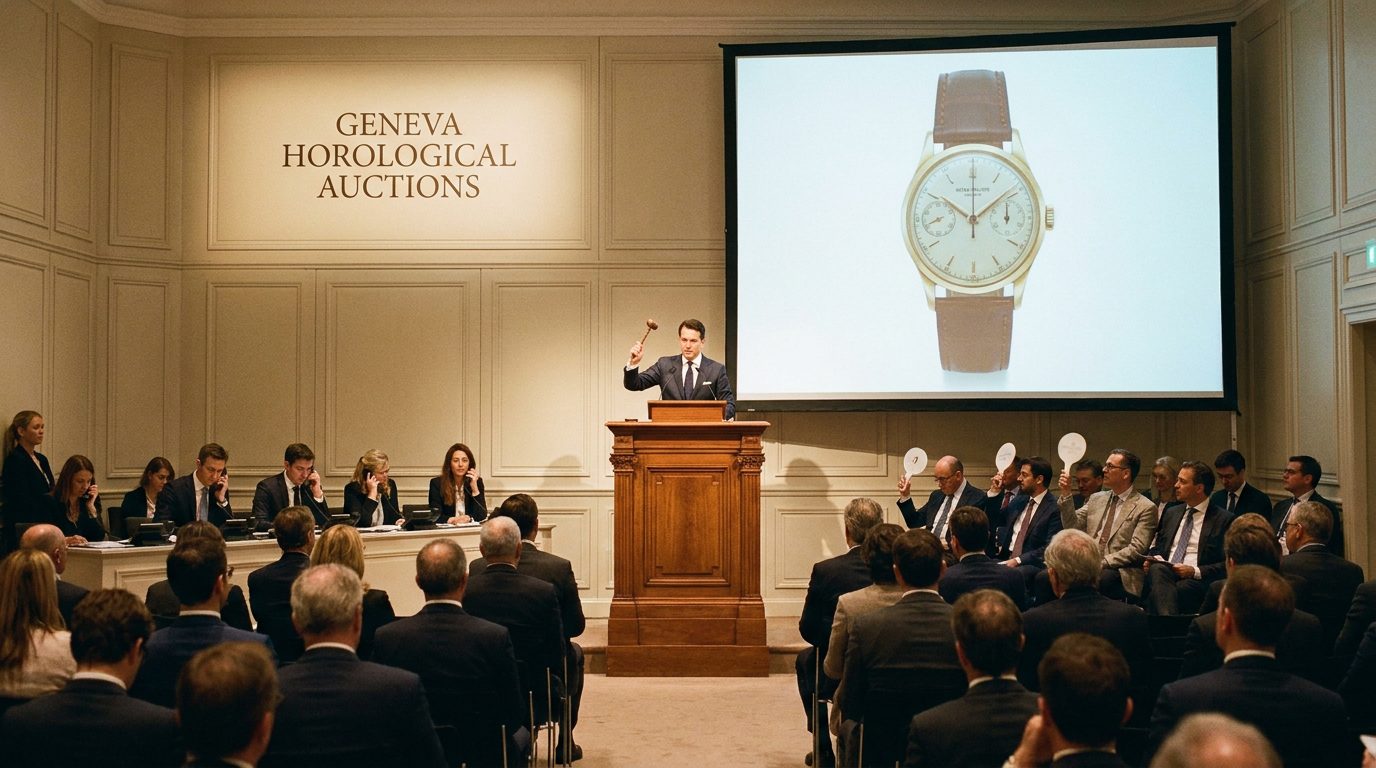
In October 1974, Osvaldo Patrizzi and Gabriel Tortella founded Galerie d'Horlogerie Ancienne in Geneva, the first auction house dedicated exclusively to wristwatches, clocks and objets de vertu. During its early years the market remained localised and academically oriented. Between 1981 and 1987 the house restructured and rebranded as Antiquorum SA under Patrizzi's leadership.
Catalogues became richly illustrated and scholarly, applying the same academic rigour previously reserved for Renaissance paintings or classical sculpture — and, in doing so, altered the perceived intrinsic value of mechanical watches. The scaffolding was now in place. What was missing was a single event that could prove how high the new ceiling could go.
The 1989 Paradigm Shift
On 9 April 1989, a single sale rewrote the wristwatch's economic relationship with its own history — and seeded the trophy-watch segment that every subsequent house would inherit.
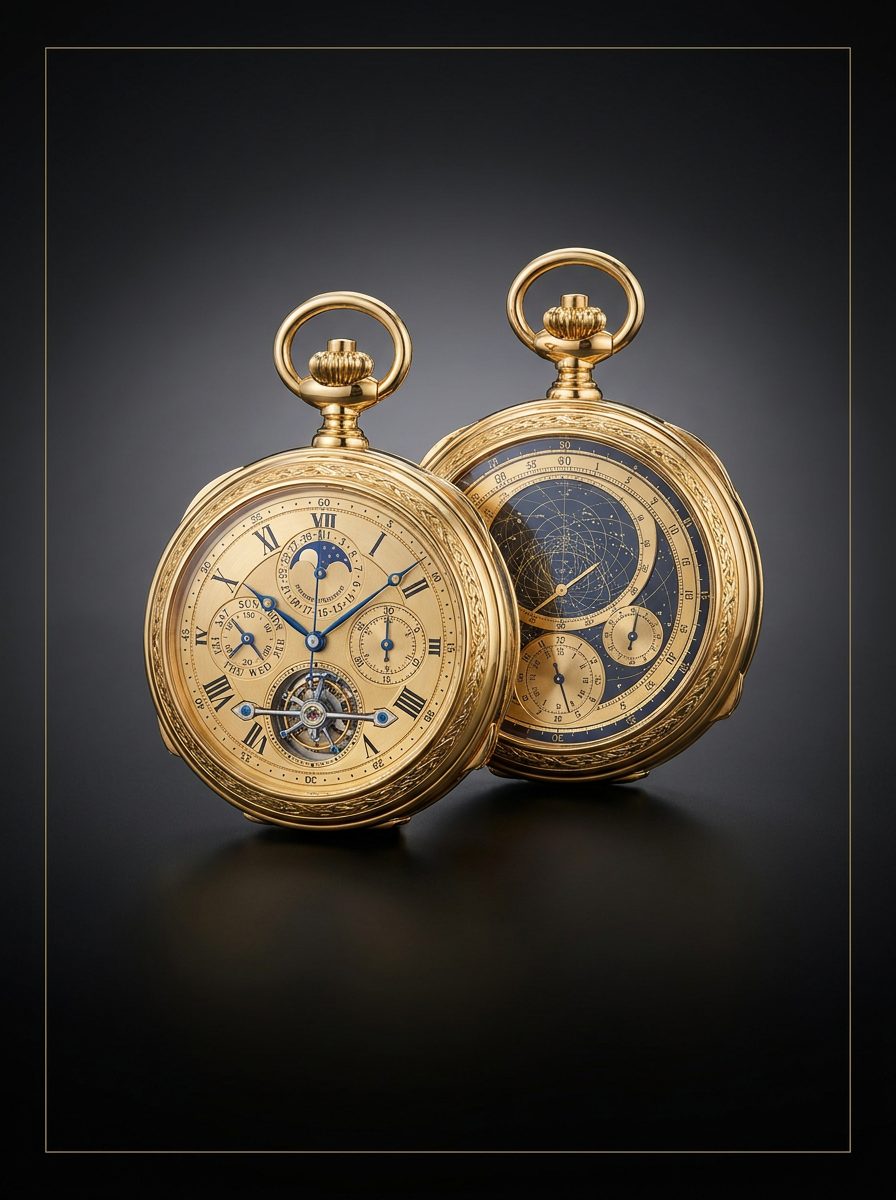
The decisive turning point arrived at the end of the 1980s amid a broader art-market boom. Antiquorum, in collaboration with Habsburg Feldman Fine Art Auctioneers, hosted "The Art of Patek Philippe" at Geneva's Hôtel des Bergues. Timed to coincide with Patek Philippe's 150th anniversary, the sale comprised 300 curated lots spanning the manufacturer's history. The centrepiece was the Calibre 89, an open-face clock-watch in 18-carat gold featuring 33 complications across five categories, including a satellite wheel that completes one revolution every 400 years to handle leap-year irregularities.
The auction established the thematic format as a permanent market driver. Several rare references from the 1989 sale later reappeared as multi-million-dollar lots at Phillips, Sotheby's and Christie's, demonstrating how a single event could seed an entire trophy-watch segment. Building on this success, Antiquorum launched "The Art of Breguet" on 14 April 1991, featuring 204 rare watches and clocks — solidifying the single-brand thematic auction as the ultimate mechanism for generating hype and exponential price realisation.
By commodifying specific references into "grail" objects, the thematic apparatus created a shadow economy. Finite historical supply could not meet demand — opening a vacuum that the very same houses frequently filled with counterfeit introductions.
The Contamination Era
From the mid-1990s into the late 2000s the market entered a sustained period of forgery infiltration — orchestrated by a single Italian counterfeiter and catalogued by the auction house that had created the conditions for him.
Italian counterfeiter Luciano Rinaldi infiltrated the ecosystem with fabricated Panerai and Rolex models. Antiquorum — at the epicentre of the market it had created — repeatedly catalogued and sold Rinaldi pieces, laundering them into elite collections and establishing false provenances. Research confirms the two operated "hand in glove" from the mid-1990s. Upon Rinaldi's death in 2016 he left hundreds of unsellable fakes, underscoring the operation's scale.
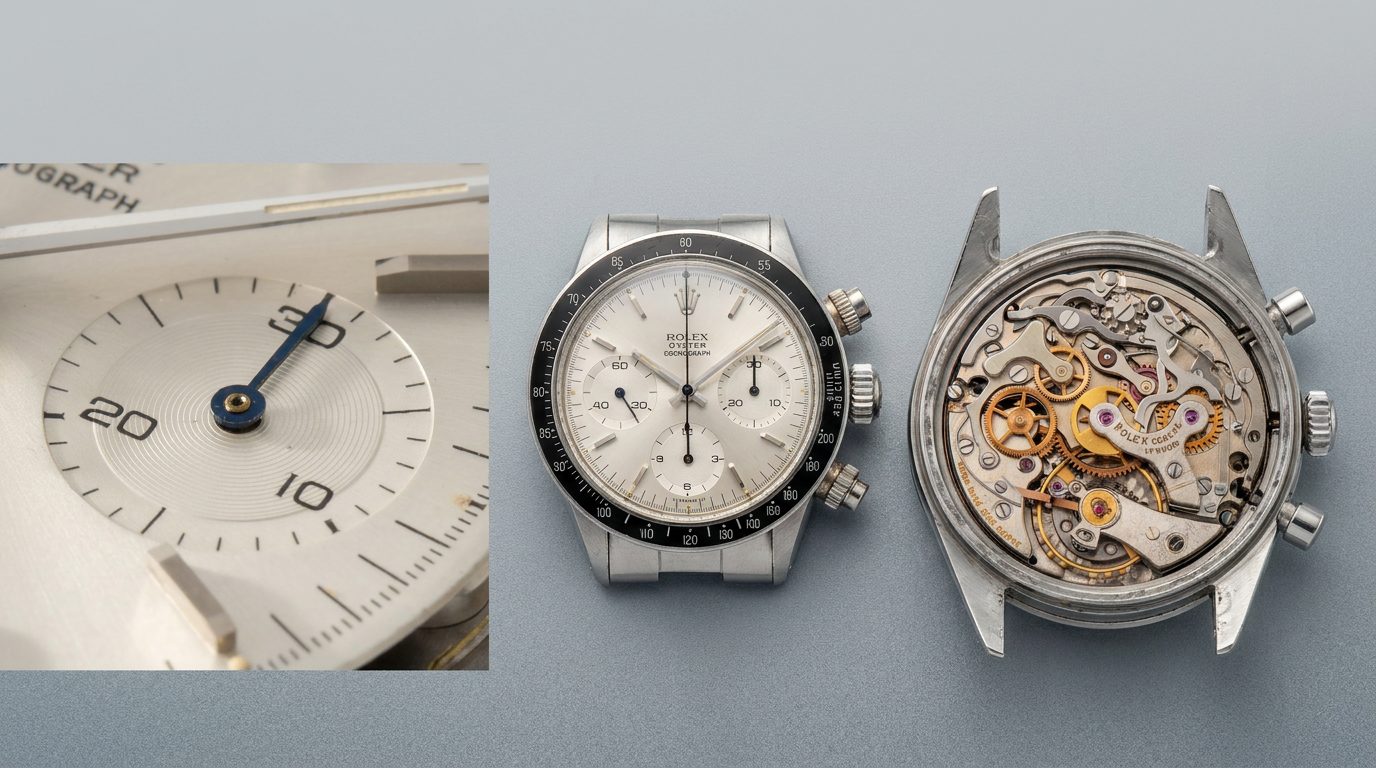
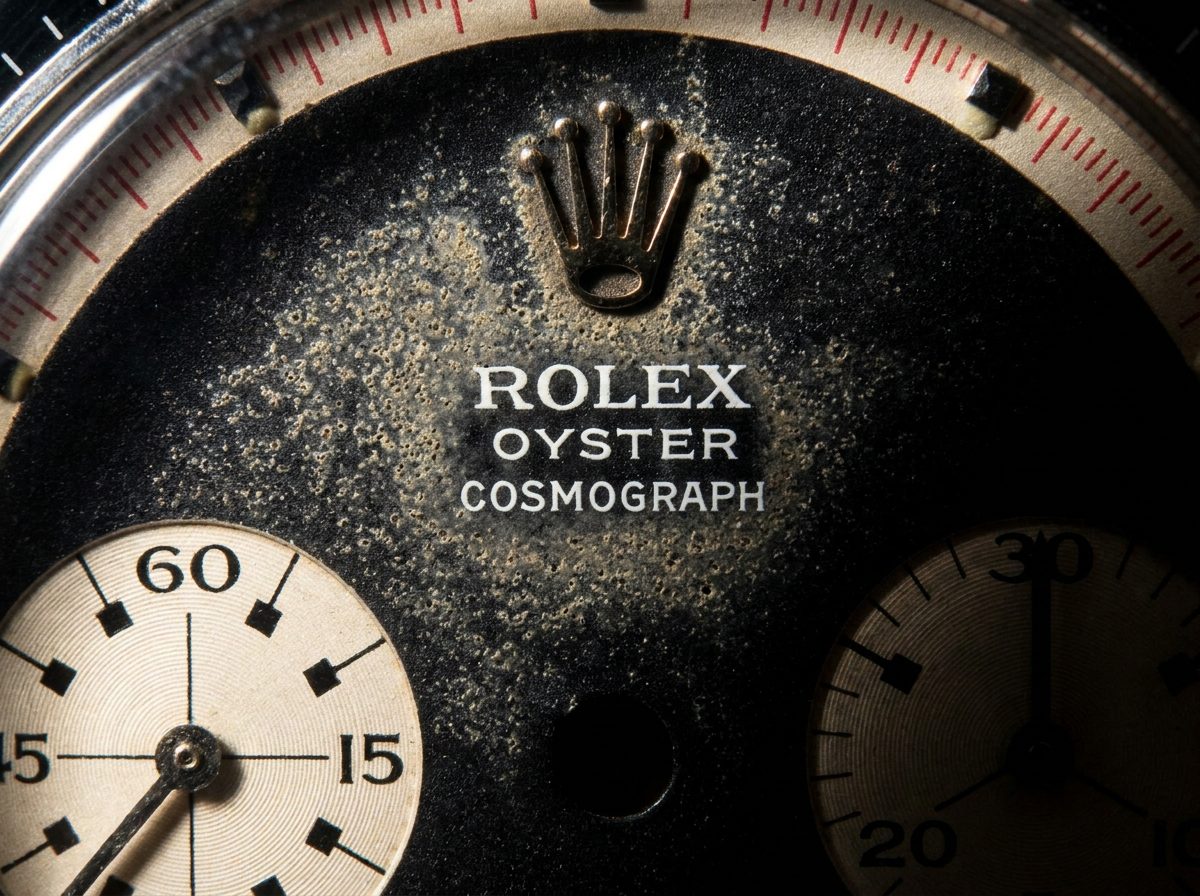
The model reached its zenith on 10 November 2013 with Christie's "Rolex Daytona: Lesson One" sale in Geneva. Curated by Aurel Bacs and Pucci Papaleo, the auction offered 50 exceptional Cosmograph Daytona examples selected for originality and condition. It grossed over $13.2 million and set 50 consecutive world records. The intense focus on specific dial variants — particularly Paul Newman exotic dials — elevated prices to the point where fabricating a single dial could generate hundreds of thousands of dollars in illicit profit.
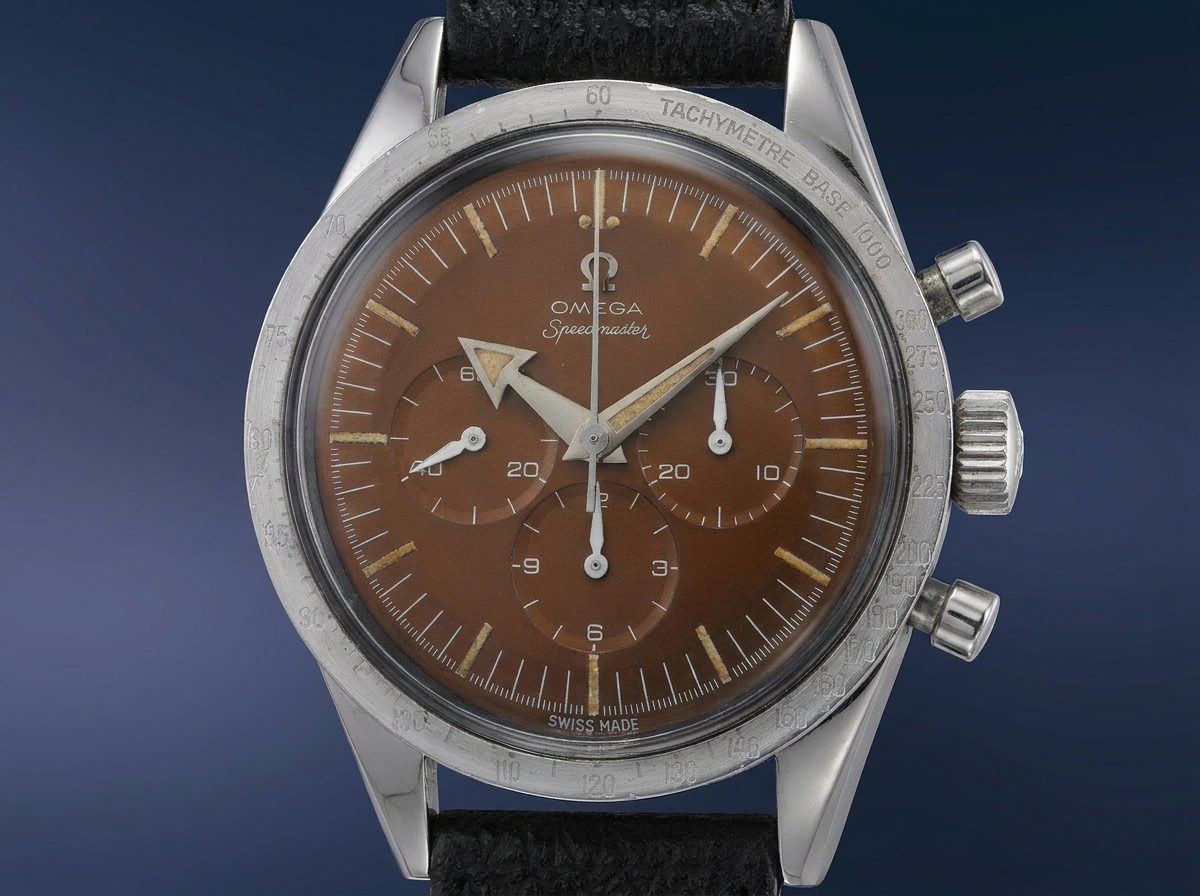
The aftermath produced a surge in sophisticated dial manipulations, directly preceding controversies including Christie's 2014 "Black Ghost ROC" Daytona sale and the 2021 Phillips Omega Speedmaster Frankenstein scandal that realised CHF 3.115 million (≈ US$3.4 million).

Architects & Counterfeiters
The market's architecture rests on symbiotic relationships among narrative creators, exploiters and monetising institutions — and understanding contamination requires examining the principal actors on both sides.
Osvaldo Patrizzi began as an apprentice watchmaker in Milan (1965–1973) before becoming a restorer and expert for the Italian Association of Antique Horology Dealers. His 1974 founding of Galerie d'Horlogerie Ancienne — which became Antiquorum in 1987 — revolutionised the sector by marketing wristwatches with the psychological and aesthetic frameworks of fine art. Lavish, research-driven catalogues supplied the academic scaffolding for astronomical valuations.
Luciano Rinaldi exemplified the professional horological counterfeiter on the other side of that scaffolding. Targeting elite collectors through informational asymmetries, he fabricated pieces from Rolex, Omega, Breitling and Longines before focusing on Panerai — exploiting the brand's prior obscurity as a military contractor lacking accessible civilian history. He perpetuated the unsubstantiated claim that Panerai archives were destroyed in the 1966 Florence flood, granting himself a blank historical canvas for inventing prototypes and assembling Frankenstein watches from disparate parts.
The thematic model's legacy has been inherited and expanded by Sotheby's, Christie's and Phillips. Structural conflicts persist: pressure to source fresh masterpieces and achieve record hammer prices compromises due diligence. When questionable pieces are accepted, houses assume the role of ultimate arbiter, deploying marketing and specialist assurances to override skepticism.
Morphological Forensics
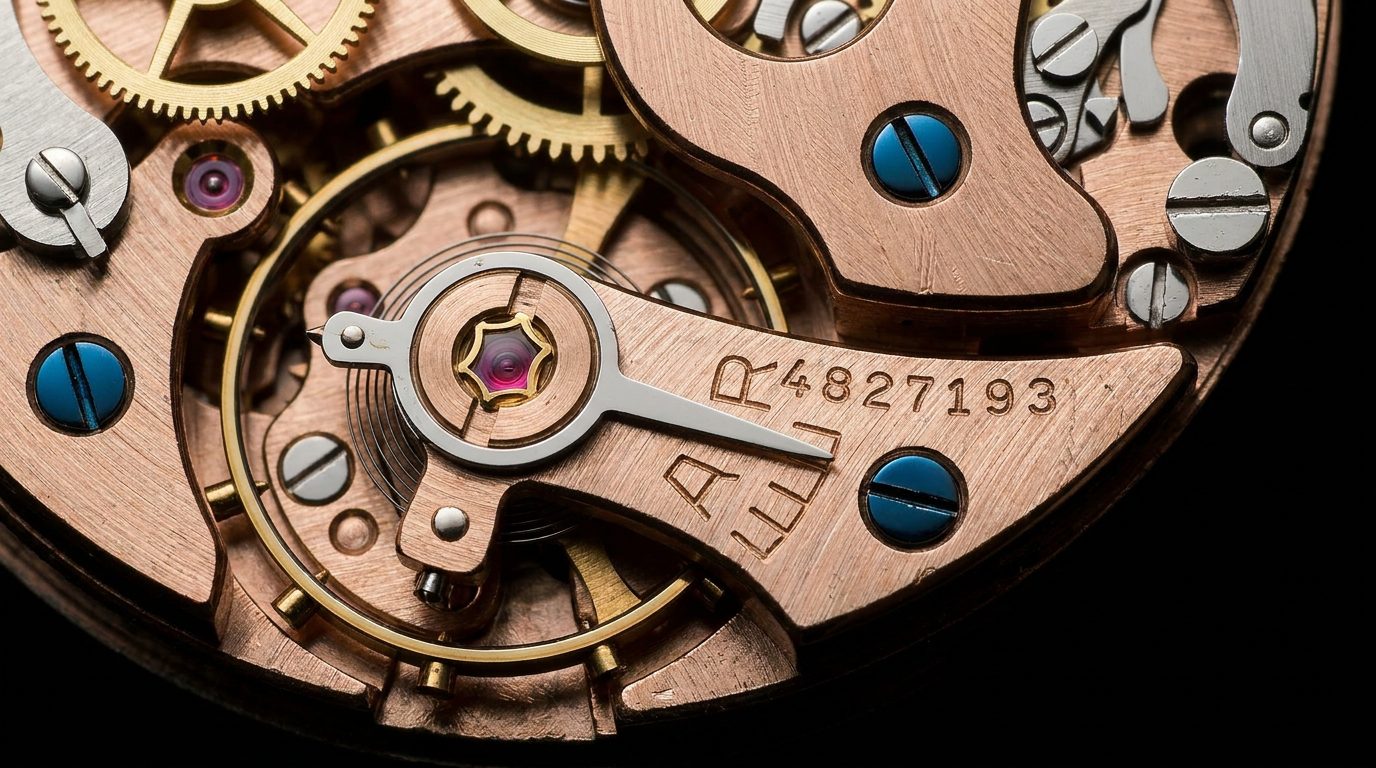
Market contamination severity becomes evident only through forensic examination of micro-anomalies in typography, chemical aging, serial alignment and case geometry.
Rinaldi specialised in fabricating military references by exploiting romanticised naval narratives. The Panerai GPF 2/56, a 60 mm maritime watch developed in 1956 for the Egyptian Navy, featured the first "Tight Seal Device" half-moon crown protector. Rinaldi produced complete fakes using black aluminium cases paired with steel casebacks — an engineering impossibility, since in saltwater the galvanic corrosion between dissimilar metals would cause immediate disintegration at the contact points. A legitimate military contractor would never commit such an error; yet these pieces circulated widely through auction catalogues.
The Rolex Ref. 5510 "Big Crown" became a prime target in its 3-6-9 Explorer-dial iteration. Rinaldi manufactured entire counterfeit case assemblies; the fatal anomalies are diagnostic:
- Dial typography featuring unnatural serifs on hour markers, violating Rolex mid-century standards.
- Incorrect typeface for lug engravings; 6 o'clock position bearing impossible "Modèle Déposé" (discontinued years earlier); 12 o'clock showing "Brevet +" instead of "Registered Design."
- Complete absence of the critical inner-caseback date stamp "1.1958" present on all authentic pieces from the narrow 500-unit batch (case numbers 361800–362299).
Antiquorum sold multiple examples regardless: March 2008 New York Lot 329 ("James Bond") for $61,360; late 2008 Lot 474 for $50,400; 2017 Lot 585 for CHF 12,500 (≈ US$14,000) despite public awareness of Rinaldi's work, described only as "reprinted"; and an April 2021 Hong Kong Lot.
The Buyer's Premium Paradox
Institutional legitimisation carries profound macroeconomic implications through a severe asymmetry between the fees charged and the guarantees provided.
The buyer's premium forms the auction house's core revenue engine. Tiered and non-negotiable, it is justified as compensation for expertise and authentication. Recent restructuring amid fine-art market stagnation has shifted burden downward toward the lower tiers — precisely where most collectors transact.
Despite premiums approaching 30%, houses refuse liability for component authenticity. Sotheby's conditions for the JPS Cherry Daytona explicitly disclaim guarantees on wheels, hands, crowns, crystals, screws, bracelets or bands, noting that repairs may replace originals. Statements are characterised as "subjective, qualified opinions." Buyers must inspect personally. This creates a moral hazard: houses extract capital via expert reputation while deploying absolute buyer-beware clauses when exposures occur.
Houses extract capital via expert reputation while deploying absolute buyer-beware clauses when exposures occur. The premium is paid for an opinion the house refuses to stand behind.
The Circular Economy of Forgery
Frankenstein sales permanently distort market indices — and the most consequential recent example reveals an ecosystem in which the manufacturer itself became the final, unwitting buyer of its own contamination.
The CHF 3.115 million (≈ US$3.4 million) Omega 2915-1 reset Speedmaster valuations globally. The scandal's ultimate buyer was Omega itself, bidding for its museum to elevate heritage prestige. The watch had been fabricated using serial numbers from corrupt former Heritage staff. Omega unwittingly purchased a forgery created internally and laundered through Phillips — illustrating a circular, compromised ecosystem in which auction incentives corrupt even brand manufacturers.
The crisis resides within institutional architecture. Sotheby's, Christie's, Phillips and Antiquorum operate in a conflicted paradigm where record hammer prices override authentication ethics. By legitimising questionable assemblies — from Rinaldi Rolex 5510s to the Black Ghost ROC, manipulated Omega 2915-1 and JPS Cherry — the houses serve as primary contamination vectors. Escalating buyer premiums juxtaposed against caveat emptor disclaimers reveal an ecosystem weighted against collectors. Until houses accept legally binding liability for component authenticity, they remain complicit in the perpetual laundering of horological forgeries.
Omega unwittingly purchased a forgery created internally and laundered through Phillips. The market did not merely fail to discover the deception — it priced the deception into existence.